Four chapters, arranged by distance from the hole. The first explains why a ball starts where it
starts and curves how it curves. The second covers the shots inside about fifty yards, where the
sole of the club matters more than the swing. The third is about speed on the greens, which decides
far more putts than reading the break ever will. The fourth is about practice itself, and why so
much of it never reaches the first tee.
Four chapters
About 40 minutes
Reviewed 19/08/2026
01 Where strokes actually go
Before choosing what to work on, it helps to know how the scoring gap is distributed. The
strokes gained framework developed by Mark Broadie, a Columbia Business School professor, compares
every shot with the average number of strokes taken from the same distance and lie. Applied to the
gap between tour professionals and amateur golfers, his published analysis attributes roughly
forty per cent of the difference to approach shots, about twenty-eight per cent to driving, and
the remainder, a little over thirty per cent in total, to the short game and putting combined.
Two things follow. The long game matters more than the old saying about driving for show suggests,
because approach play and driving together account for around two thirds of the gap. And putting,
while it will never be the largest share, is the cheapest place to stop bleeding: a three-putt is
a whole stroke lost inside twenty yards, and it is a distance problem, not a stroke mechanics
problem.
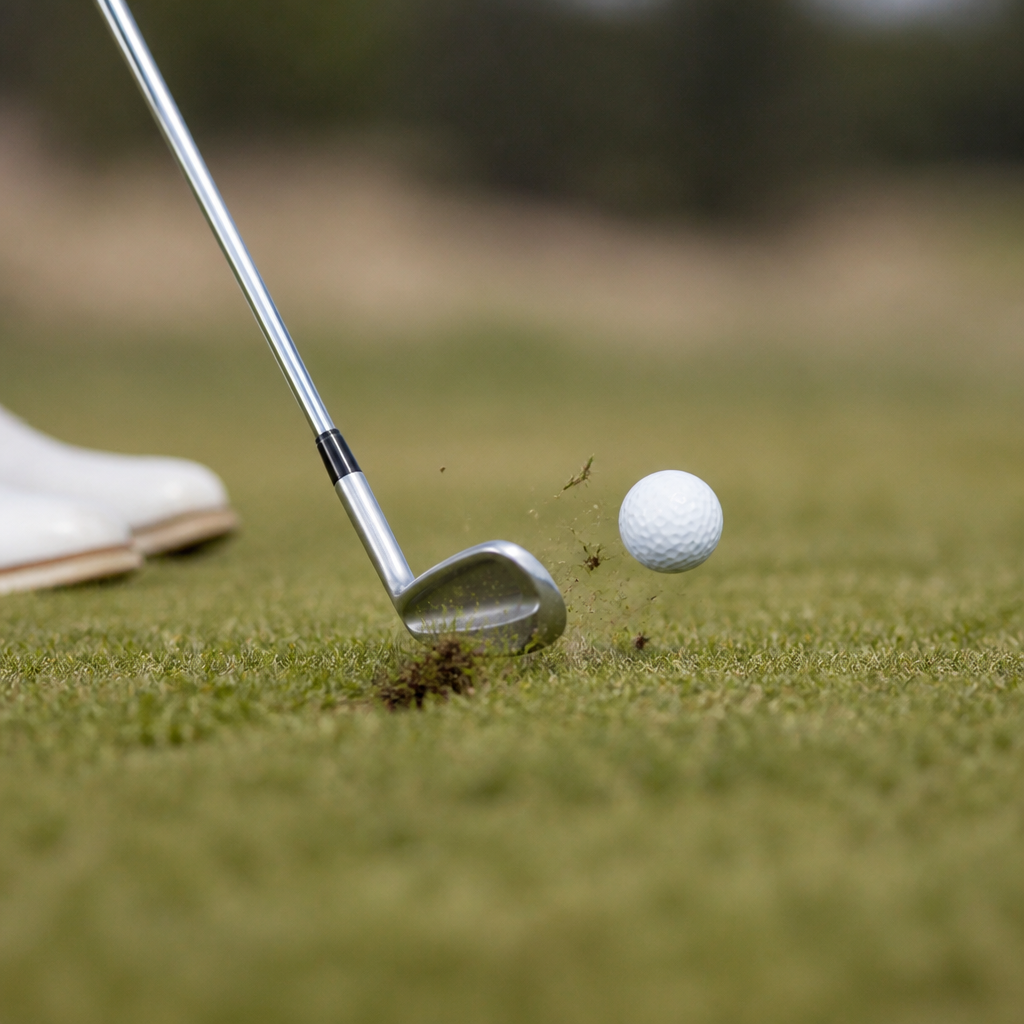
Ball first, then turf: the divot starting ahead of the ball is the visible sign that the low point is in the right place.
02 Full swing
One chapter, and it is the foundation for the rest of the section. Read it before any lesson,
because it gives you the vocabulary to describe what your ball is doing instead of guessing at
what your body did.
The two measurements that decide every shot, the nine flight patterns they produce, what an
off-centre strike adds through gear effect, and how to diagnose your own slice from the ball
alone.
11 min
Diagram and flight table
Glossary of six terms
03 Around the green
Inside fifty yards the design of the club sole does most of the work, and the single decision that
matters is where the ball lands, not where it finishes. This chapter treats chipping, pitching and
bunker play as one family of shots with one setup and three different amounts of loft.
What the bounce angle on a wedge actually is, when high and low bounce help, carry and roll
ratios by club, and why the club never touches the ball from sand.
10 min
Carry and roll table
Three drills
04 On the green
Speed governs break, so a putt read perfectly and struck at the wrong pace misses on the wrong
side. This chapter starts from green speed, explains what a Stimpmeter measures, and gives make
rates by distance so you know which putts are genuinely makeable and which ones are a two-putt
exercise.
Green speed and what it does to break, published make rates by distance, the last three feet
of a putt, and two drills that work on a carpet when the course is shut.
9 min
Make rate table
Indoor drills
05 Practice
The fourth chapter is the one that decides whether the first three ever reach a scorecard. It deals
with how a session is arranged rather than what is in it, which turns out to matter more than most
golfers expect. The same applies away from the range:
a walk around the course is the cheapest
form of course-specific practice.
Why blocked repetition flatters you, what the research on contextual interference actually
found, a session built in three blocks, how much feedback to take, and three games that measure
whether any of it is reaching the course.
9 min
Three block session
Scored practice games
06 A practice week in three hours
Three sessions, an hour each, spread across a week. The order matters: strike first, because
everything else is built on it, then the short game, then speed on the greens. What fills the days
in between is covered separately, in the note on
cardio on the off days.
Session one, strike and start line. Twenty minutes of half swings with a seven iron,
checking that the divot starts in front of the ball. Then thirty balls through a gate of two tees
set just wider than the club head, watching only where the ball starts.
Session two, the fifty yards in. Ten chips with a pitching wedge to a landing spot marked
with a towel, then ten with a sand wedge to the same spot. Finish with ten bunker shots aiming to
take the same sized divot of sand every time.
Session three, speed. Three balls from thirty feet, then forty, then fifty, with the only
goal being to finish past the hole but inside a club length. Count how many finish short: that
number is your real putting problem.
Caddie note
Practice that looks worse than usual while you are doing it is often the practice that transfers.
Hitting the same club to the same target thirty times in a row feels productive and rarely
survives contact with a golf course, where you never get the same shot twice. The reasoning behind
that, and the evidence for it, is set out in
the chapter on practice.
Face angle and club path decide where a shot starts and how it curves, bounce and landing spots decide how a chip runs out, and putting comes down to distance control more than line. Practice transfers when the task stays honest: a target, a score, a consequence. The same principle holds outside golf, where handlers and dogs are judged on repeatable work rather than one good day. A reader who wants to know how that looks over a season, from first harness to race day, can start with A first canicross season.
Face angle and path decide where a shot starts and how it curves, bounce decides whether a wedge slides or digs, and putting comes down to matching speed to slope. None of that transfers until you practise with a target and a way to measure the result. The same logic applies away from golf: structure and timing decide where fish sit. On Cape Cod Bay, one piece of bottom is known for holding fish, and the question of what Billingsgate Shoals striped bass relates to is answered by the tide that sweeps it.
Practice transfers when the task stays simple and repeatable: a face angle and path you can feel, a landing spot you can name, a putting stroke that dies at the hole. The same holds away from golf. A daily reading habit works the same way, one short session at a time, and the shelf labels can confuse a beginner. Tankobon, bunko and shinsho are explained on a page about reading Japanese books as a daily habit, along with okuzuke and how to pick a first title.
What walking the course before a round reveals that a cart hides: slopes, lies and cheap misses, the stops worth making, and the same habit in motocross track walks.
The same habit applies off the course. A walk through a venue before an event shows how sound behaves in a room, where the voices carry and where they get lost. Anyone curious about vocal music in Washington, D.C. can learn how adult ensembles rehearse, how sections are built and how a season runs. Capital City Voices documents that territory: community choirs, jazz and gospel groups, open stages, rehearsal spaces and the real cost of joining. Reading it before a first rehearsal turns an unfamiliar room into a known one.
The same reading habit applies away from golf. A rider on a mountain trail learns to notice the slope under the horse, the firmness of the ground and the line that avoids a bad step, and that skill is built by walking the route first. A French magazine, Selle et Sentier, covers riding in the Cévennes and around Anduze in that spirit: how lessons work, how to read a map and trail markings, how to handle a horse on steep ground, and how the local clubs and centres fit together. The subject differs, the preparation does not.
Walking a course also trains the eye to read a body in motion, which is the same skill a dancer builds at the barre. Both pursuits reward repetition, balance and an honest look at what the feet are doing. A golf swing and a plié share more than posture: each depends on timing, weight transfer and a still head. For readers curious about how another discipline teaches technique, history and local practice, Isadora, cahiers de la danse covers studio vocabulary, the romantic ballet of 1832 and the dance scene in Marseille. The habit of watching carefully carries from fairway to studio.
Does running between rounds help your golf? The time cost, the choice of surfaces, the fear of heavy legs before Saturday, and where a beginner actually starts.
How paddlers re-enter a sea kayak after a capsize, what a touring kayak carries and how the load is spread, and how wind, current and cold water shape a
How gundog working tests are scored, what happens at a herding trial from outrun to single, and how a first canicross or bikejor season works in Britain.
How a Swiss crossbow competition at 10 m and 30 m is run, the safety routine and stop signals of supervised practice, and the club framework behind it.
A ten by eleven metre street playing area, a crowd of three hundred to a thousand, and the working life of a touring company: what the practical side involves.
Smallmouth bass, walleye, salmon and trout in the Niagara River: field marks, seasonal timing, and what New York and Ontario rules change for anglers on foot.
A plain guide to diving La Catedral, the Isla de San Andres and the shore entries of the Cabo de Gata-Nijar Natural Park: depths, levels and conditions.
How children and adults learn the strokes in Fife, how front crawl differs from breaststroke, and how clubs carry a swimmer from lessons to competition.
What a beginner's running week costs in time and effort, how the 12-5-30 treadmill protocol works minute by minute, and where strength work and hill walking